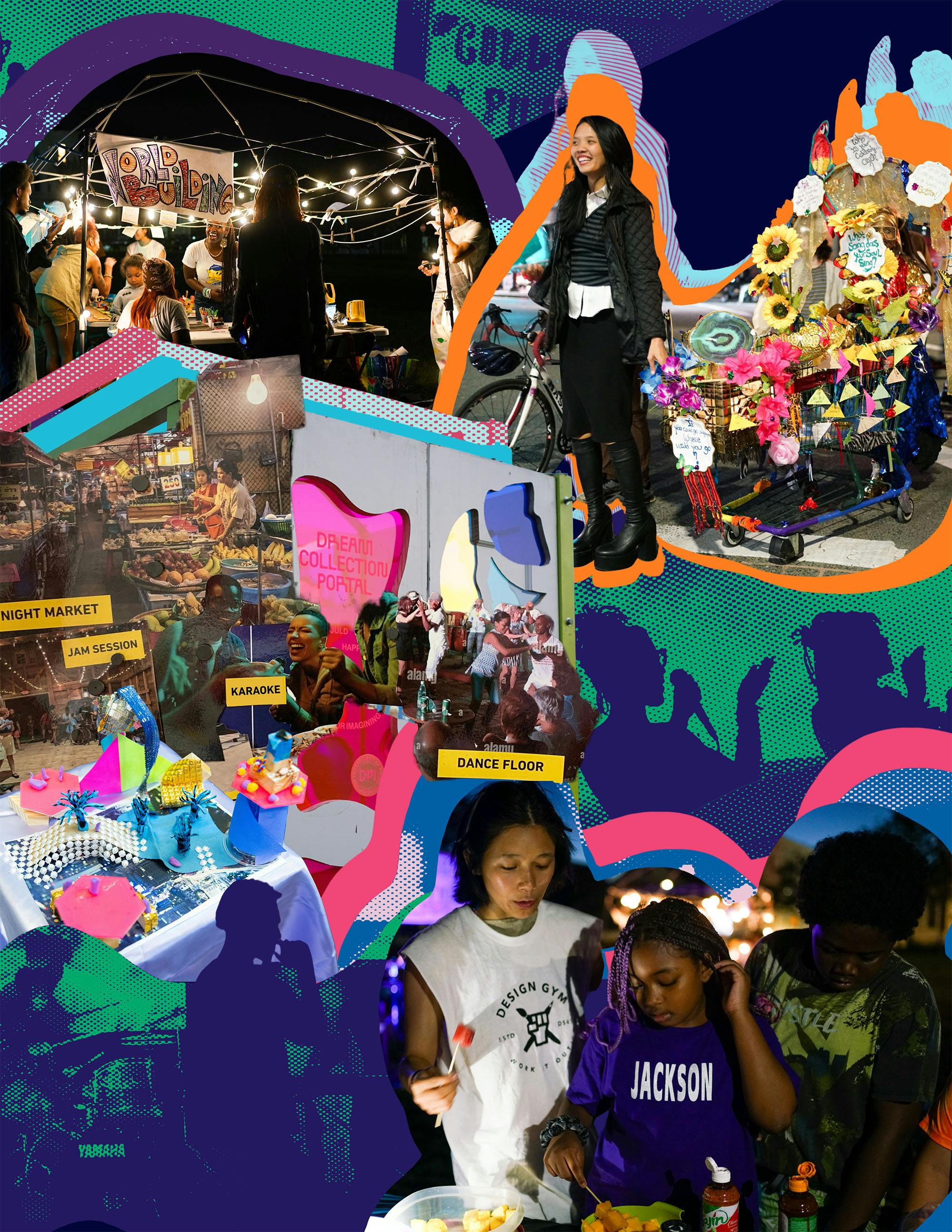
Nightlife For All
A call to reimagine Boston’s public life at night
An independent study conducted by the Design Studio for Social Intervention (DS4SI) and VibeLab.
About the
Project
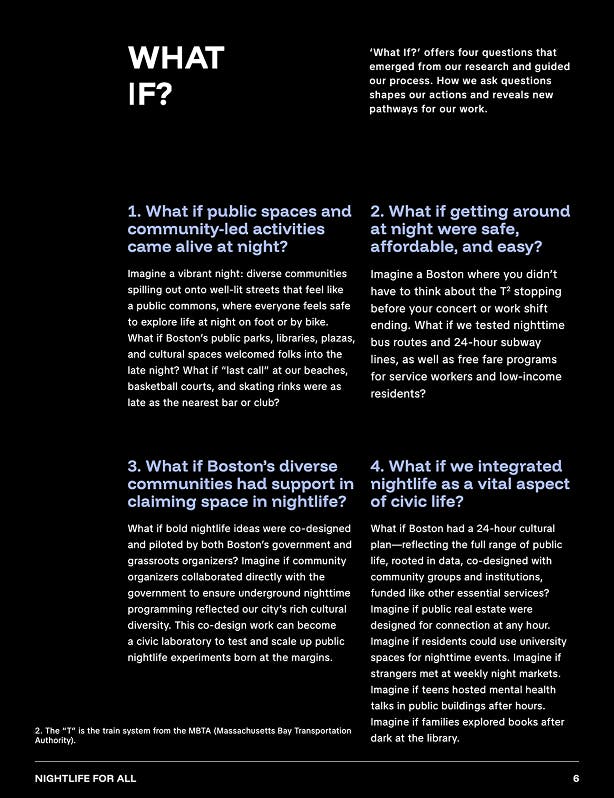
What if public spaces and community-led activities came alive at night? What if getting around at night were safe, affordable, and easy? What if Boston’s diverse communities had support in claiming space in nightlife? What if we integrated nightlife as a vital aspect of civic life?
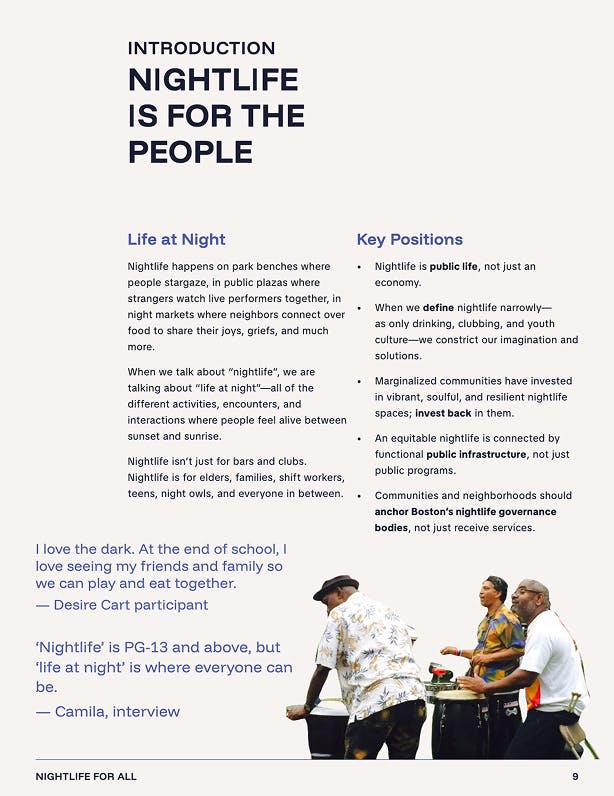
This paper encourages a more capacious and democratic imagination of what nightlife in Boston can be.
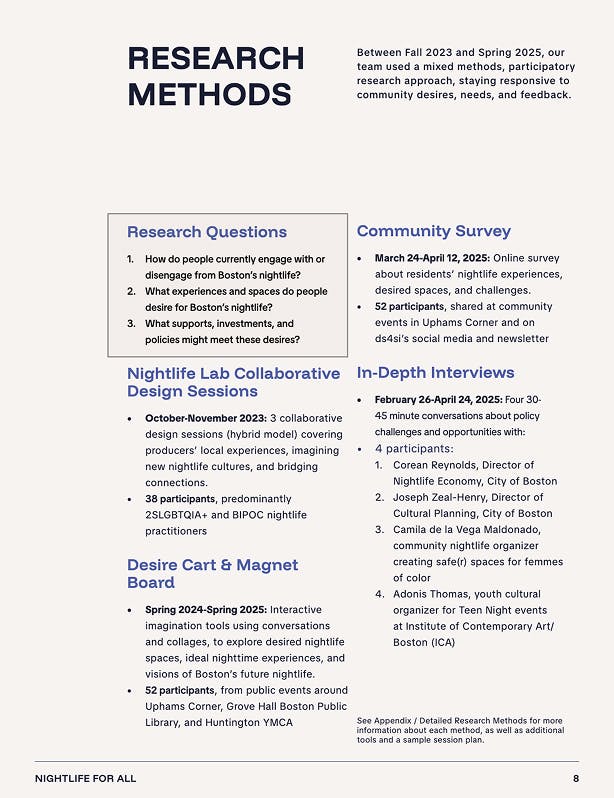
Through our 1.5 years of engaging diverse communities and nightlife practitioners, we heard people’s desires for a more vibrant, inclusive, and creative nightlife in Boston. This report combines their insights and imaginings with inspiration from global case studies. Our findings and recommendations are arranged across 3 key themes: Belonging & Diversity, Space & Infrastructure, and City-Community Collaboration.
72.7% of non-binary and gender-queer respondents to our survey named ‘feeling unwelcome to organize events’ or ‘feeling unwelcome to participate’ among their top two barriers to engaging with nightlife.
0% cisgender respondents identified those feelings among their top 2 two barriers.
“17 year olds are absolutely out at night but there’s nowhere to go except for a sketchy public park...I want to walk into a tea house that is open every single day, from 7PM until 2AM and see a 15 year old and then a 65 year old just doing their thing.”
— Mycah, Magnet Board
Global Case Study:
How might a government office protect marginalized cultural spaces and hold institutions accountable?
Founded in 2016 as a first-of-its-kind initiative within the Greater London Authority (GLA), this Office safeguards cultural community spaces threatened by rising costs and displacement, as part of the Mayor’s Cultural Infrastructure Plan. They use research, mapping, and data-driven advocacy to influence and integrate planning and policy at the city level. They also offered direct support, heritage protection, and targeted funding. The Office created public charters such as the LGBTQ+ Venues Charter: a five-point pledge for venue operators, developers, landlords and local authorities to protect queer spaces, reversing their citywide decline. In its first year, they helped 200+ at-risk spaces. They have inspired other cities like New York to explore replicating its integrated model.
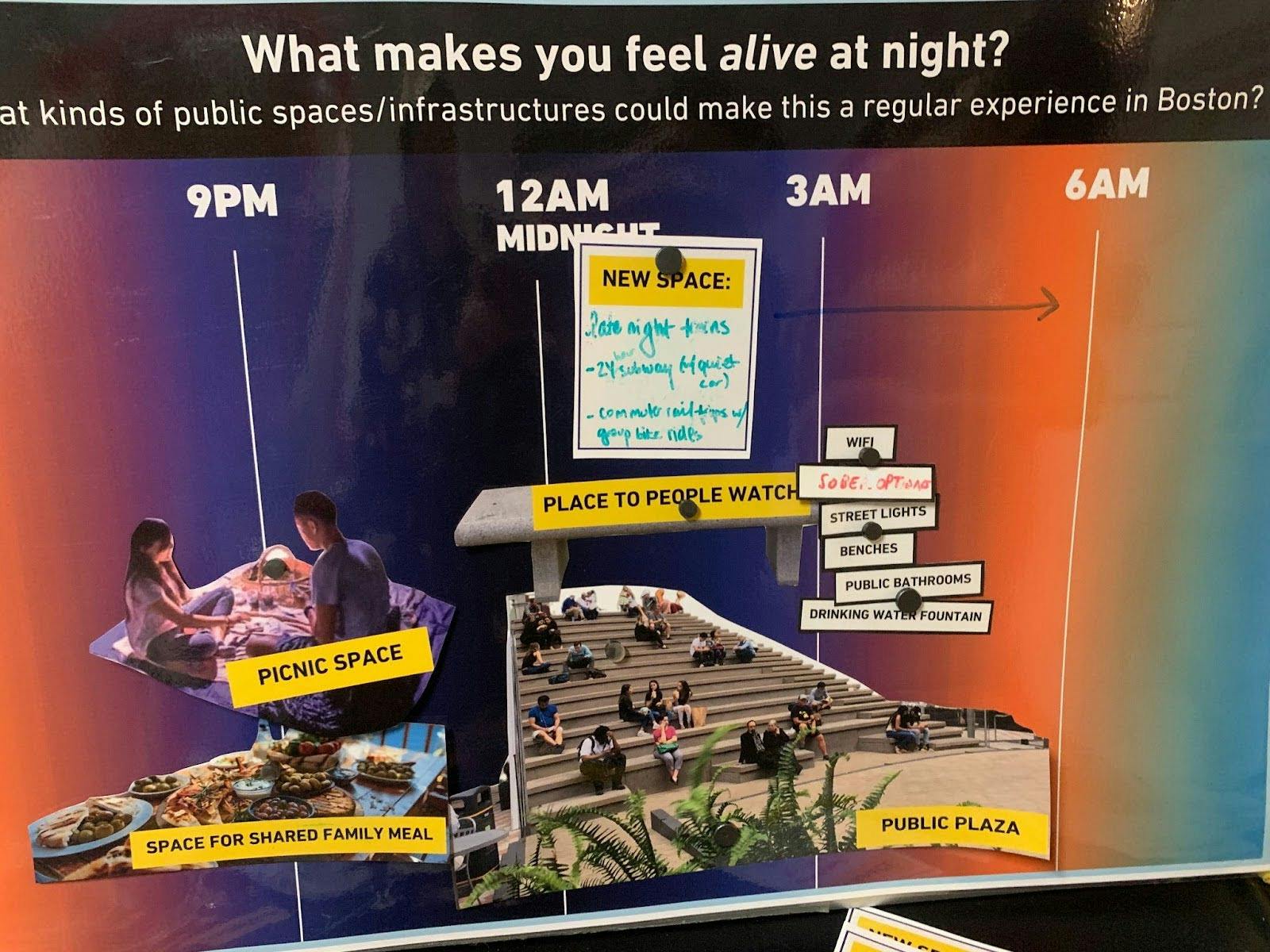
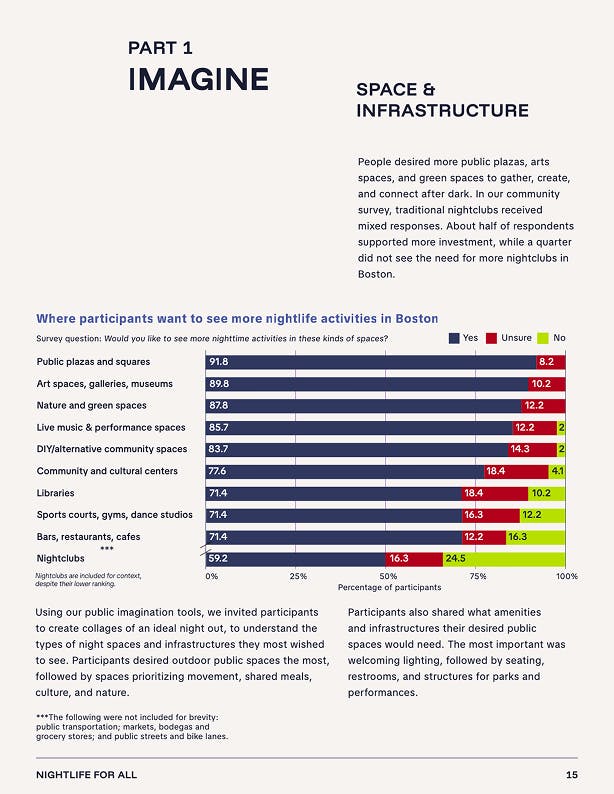
Types of nightlife infrastructures most desired in Boston by participants
Magnet board question: What public infrastructures do you want to see at night?
Global Case Study:
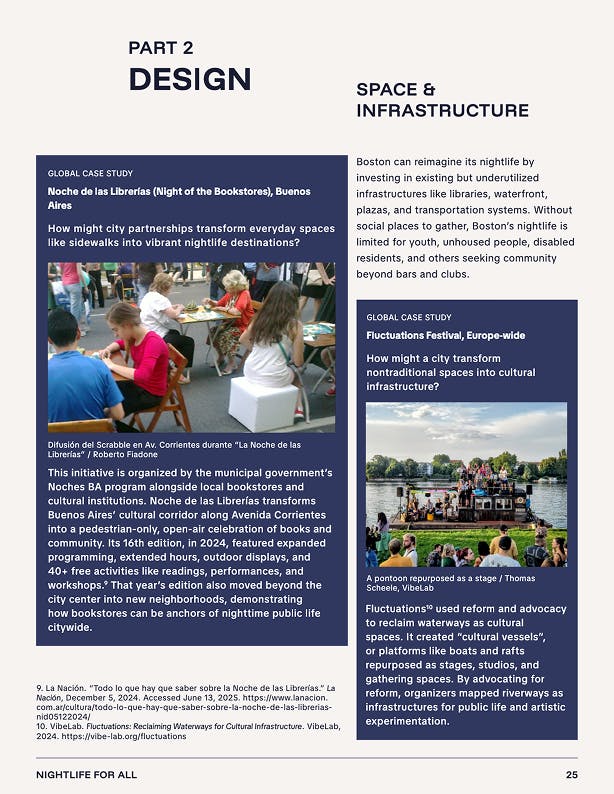
How might city partnerships transform everyday spaces like sidewalks into vibrant nightlife destinations?
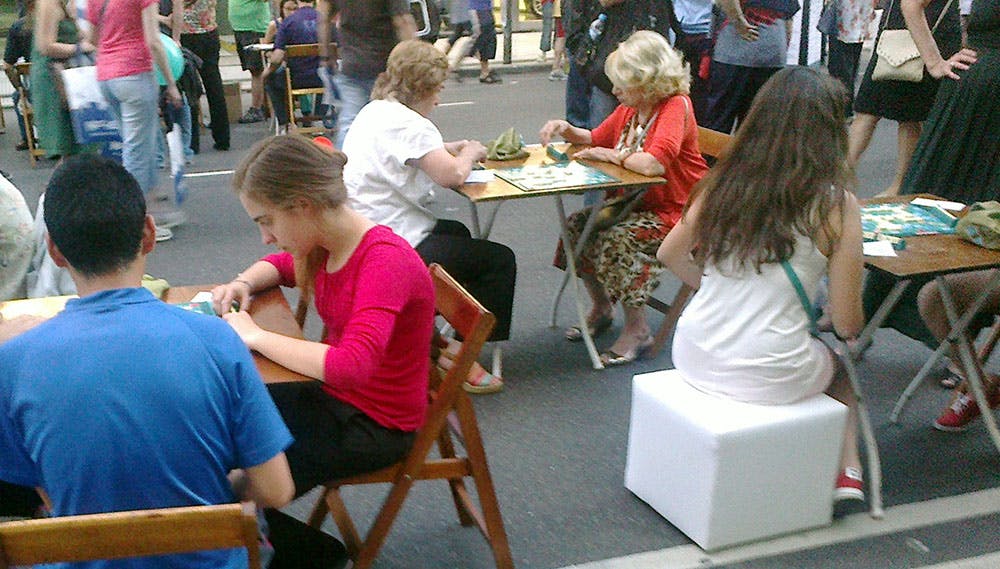
This initiative is organized by the municipal government’s Noches BA program alongside local bookstores and cultural institutions. Noche de las Librerías transforms Buenos Aires’ cultural corridor along Avenida Corrientes into a pedestrian-only, open-air celebration of books and community. Its 16th edition, in 2024, featured expanded programming, extended hours, outdoor displays, and 40+ free activities like readings, performances, and workshops. That year’s edition also expanded beyond the city center into new neighborhoods, demonstrating how bookstores can be anchors of nighttime public life citywide.
"From a policy perspective, I would like to see an understanding that with more vibrancy comes a safer city. There might be a little bit more sound emitted in the evening time, but that can allow for safer streets. Utilizing nightlife to reinvigorate community building is very important."
— Corean Reynolds, Director of Nightlife Economy, City of Boston
Global Case Study:
How might a nightlife strategy integrate nighttime mobility with city planning?

Owl Bus was launched to serve late-night commuters between 12-5AM. This service uses participatory data collection, real-time operations analysis, and inter-agency coordination to map community mobility needs and optimize routes. What began as a two-route pilot expanded to nine routes, drawing on a six-month on-site survey and analysis of late-night mobile call volumes. Citizens participated in developing the service’s brand, name and logo. The initiative engaged transport, social services, and the private sector while prioritizing accessibility for economically disadvantaged residents. This data-driven, citizen-centered initiative shows how mobility, equity, and community input can shape responsive nighttime infrastructure.
Key Recommendations
1. Experiment with Nightlife as Civic Life
2. Co-Design A 24-Hour City
3. Expand City-Community Partnerships
4. Prototype Equitable Nighttime Infrastructures
5. Publicly Celebrate Community Nightlife
6. Incentivize Community Peer Networks
Preview the report
Download